
Egypt and Iran Play to Suspenseful 1-1 Draw, Keeping Iran’s World Cup Fate in the Balance While Egypt Advances to First-Ever World Cup Knockout Stage
By Niko Antoun
Seattle, WA- Iran and Egypt faced off in their final group stage match of the World Cup, resulting in a 1-1 draw between the two sides. The opening and closing stages of the match were particularly exciting and electric, with both goals and a missed penalty coming early on and a controversial disallowed Iran winner coming in the final minutes. It was a mostly cloudy Friday evening at Seattle Stadium with coolly felt winds, and 66,925 fans filled out Seattle Stadium to mark another full house.

Aimee Worthington / Area Sports Network
Alongside Belgium advancing for the ninth time in their history, Egypt advanced to the World Cup knockout stage for the first time ever with the draw. Iran’s World Cup fate will depend on the matches the next day, having made third place on three points, so every Iranian will be watching the games involving Algeria, Panama, Ghana, and the Democratic Republic of Congo closely.
“History is written, we qualify for the first time ever,” said Egyptian goalkeeper Mostafa Shobeir. “We’re super proud … and again, we’re looking forward to the next game.”
Egypt kept 61% possession, maintaining the ball for the majority of the match and registering more shots. However, Iran was the overall attacking threat. Especially near the end of the game, the amount of expected goals for the Iranians was 1.97, whereas Egypt had 0.84.
Iran was particularly strong on the counterattack, which distributed the weight of their attacking threat against the run of play. Shobeir spoke about his team’s defensive effort against Iran, saying his defenders “were amazing,” commenting on how the last-ditch tackles in Iran’s close opportunities kept the score level: “It’s amazing, again, all the players did well, and again, we knew before the game that’s gonna be a tough, tough, tough opponent and they’re good in the high goals in the everything. Set pieces also. We studied them well, and then unfortunately we concede a goal but it was cancelled through a set piece. We’re gonna study again, ourselves. We’ll see what we can improve.”

Aimee Worthington / Area Sports Network
Mohamed Salah started at central attacking midfield of Egypt’s 4-2-3-1 formation, playing his second game at Seattle Stadium, where he played 57 minutes when replaced by Zico, as the game was still on. Iran’s star striker Mehdi Taremi also started the game, playing every minute and almost winning the match for Iran.
Group G was a tightly contested group, with Egypt being the only side going into matchday three to have a win. Top-three-wise, all Belgium, Egypt, and Iran were ultimately battling for the top spot. If Egypt had lost and finished in third place, it would have been guaranteed to advance with four points. The progression scenarios were primarily focused on Iran and Belgium, who both entered this matchday on two points each and needed a positive result to be chanced at advancing to the knockouts.
New Zealand also entered their match needing a win to advance on four points, and while the Kiwis were not out of the competition mathematically, defeating Belgium was a tough ask for the lowest-ranked team in the FIFA rankings. Belgium and New Zealand kicked off at BC Place at the same time as Egypt vs. Iran, which ended in a 5-1 victory for Belgium to ensure their place in the Round of 32 as Group G winners.
Prior to the match, protestors gathered in front of Seattle Stadium to demonstrate against the Iranian regime. Picket signs, bullhorns, and an abundance of pre-revolutionary Iranian flags filled the planned demonstration areas on Occidental Avenue. Earlier the same day, as Iran prepared to take the field for a World Cup match on US soil, media outlets reported that the US struck Iran for the first time since the ceasefire agreement was signed. As the national anthem of the Islamic Republic of Iran played, some booing was heard in the stadium.
Following the final whistle, Iran was again forced to head straight back to Tijuana on the same evening, continuing the unjust and unequal treatment that Team Melli had to endure in the United States with the ongoing geopolitical situation. Mehdi Taremi voiced his anger and frustration directly during the media availability, saying “We always complain about this since the beginning. It’s a disaster World Cup. Disaster … I mean FIFA, they have to solve every problem here but unfortunately, they couldn’t solve since the beginning.” There was also no Iranian media present at Seattle Stadium.

Aimee Worthington / Area Sports Network
Taremi said that FIFA President Gianni Infantino came into the Iran dressing room but complained that nothing has improved Iran’s situation. “We don’t have out logistic people here, they don’t have a visa. How possible you always have to travel to Tijuana. We love people of the Mexico, we love Tijuana, it’s so good, they are so humble people. We love them, but as a professional players, professional competition, it’s not right … without recovery, without nothing, it’s not fair.”
Iran goal scorer and the game’s Superior Player of the Match winner Ramin Rezaeian was saying after the game that he did not wish to talk about the situation but addressed the people of Iran: “My people in Iran deserve more than everything, they deserve more happiness, they deserve anything. But now we did our best just for our people.”
“We always do our best, we play for our people,” said Taremi. “We want them to be happy, we want to bring them the joy, we want to send the message peace for the people in Iran, outside the Iran, for the FIFA, for everyone. But there’s no peace about the others to us.”
The setup of this match was also unique and controversial, with the first-ever FIFA pride match being selected for the fourth World Cup—coinciding with Seattle’s annual pride weekend that is set for the end of every June—given that homosexuality is illegal in both Egypt and Iran. Around the stadium, among a mix of Egyptian and Iranian flags and gear were pockets of various pride representation—evident in the rainbow flags, shirts, and assorted pride merchandise.
Many of the players did not comment or say much about the Pride celebration involved within match. Taremi did leave a remark on the matter, saying “Our religion doesn’t accept that, but we respect all of the LGBT people. That’s their own idea. It’s not about us. We are here to play football. We respect all of those guys.”
The opening stages of the game were an electric start to the game that consisted of goals, saves, and high energy. Egypt opened the scoring very early in the match, with Mahmoud Saber finding the gap between Iranian defenders and the legs of goalkeeper Alireza Beiranvand at the 5th minute, off a rebound that Beiranvand knocked into the top area of his penalty box.

Aimee Worthington / Area Sports Network
“A great honor for anyone to participate in the World Cup with their national team. Thank God he blessed me and I was able to score in the World Cup,” said Egypt goal scorer Mahmoud Saber, translated to English from Arabic. “May God grant us success and we’ll make The Egyptian people happy next match.”
Minutes later, Iran won a penalty after Saeid Ezatolahi miskicked the ball and inadvertently took down Taremi in the Egyptian penalty area. Taremi stepped up for Iran to find the equalizer, and he placed the penalty to the low left-hand side of Ahmed Shobeir. Shobeir was able to read Taremi’s penalty, though, and he saved the penalty to retain Egypt’s 1-0 lead.
“There is no word about the game because we did our best during 90 minutes,” Taremi was saying after the game, talking about treatment of the Iranian team and the match itself. “We are proud of ourselves. If anything happen, it’s my responsibility because I lose the penalty. If we pass the group stage, thank God.”
After a stoppage for an injury that forced Egypt’s Mohamed Abdelmonem out of the match, Iran kept putting the pressure on the Egyptian backline and forced the equalizer off a rebound after a fantastic save by Shobeir from a shot by Ezatolahi. Fullback Ramin Rezaeian followed through on the rebound with a lightning bolt of a finish into the top-left corner from a tight angle.

Aimee Worthington / Area Sports Network
Following the first hydration break, Egypt began to maintain control over the game’s momentum, though Iran was allowing the Egyptians a difficult time to find an opening. Iran found a promising opportunity before halftime with a one-on-one header with the goalkeeper but saw the ball go wide following the cross.
Most of the second half was relatively tame, as Iran kept holding off Egypt’s attack, though the Egyptians kept most of the possession and attempted more shots after the halftime break. Iran looked a bit more dangerous when on the attack, posing a sharper threat to take the lead in pockets of momentum.
The suspense shifted dramatically in the final moments of the game, when Iran struck the upper corner of the crossbar. Off a corner sent in by Rezaeian, Taremi beat Shobeir to the ball to land a powerful header onto the woodwork. Iran was determined to secure this victory while reversing Egypt's momentum.
In the middle of stoppage time, Iran thought they scored a vital late winning goal to send them directly into the Round of 32, but it was cut off by VAR due to a very tight offside decision. The opportunity came from a distant free kick sent into the box by Rezaeian again, where Shobeir could not get to the ball in time to punch it out of danger.

Aimee Worthington / Area Sports Network
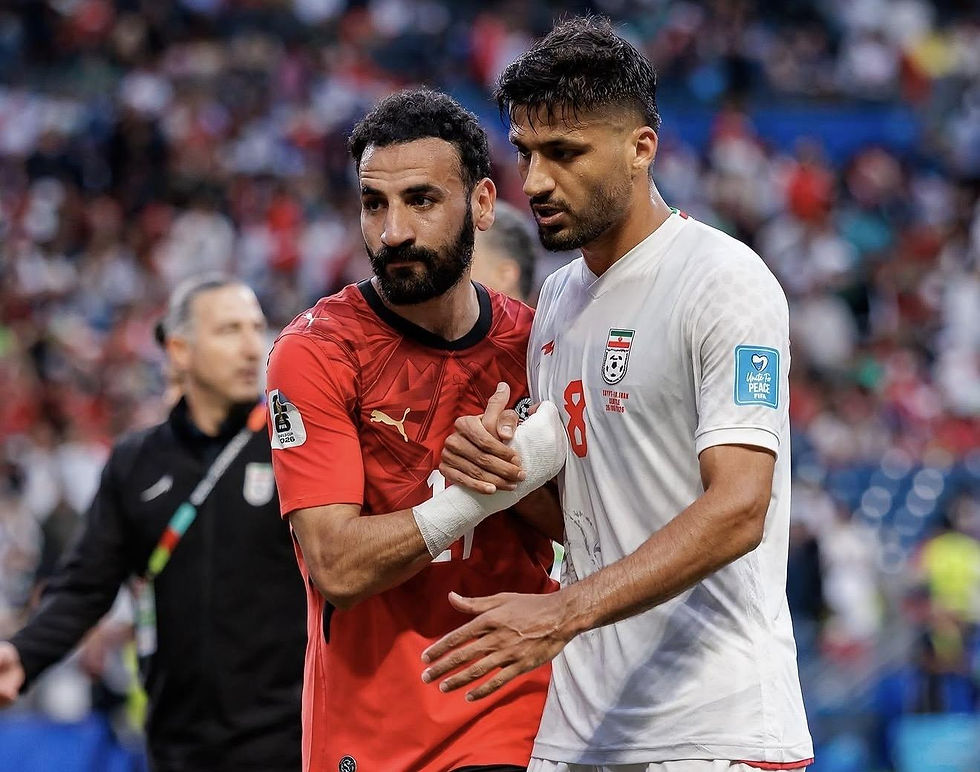
Saeid Ezatolahi found the header to cause a scramble in the Egypt penalty box, and with Shobeir consequently off his line, Mohammed Ghorbani reacted to the ball bouncing, shooting the ball to be blocked by Rami Rabia, and eventually Shoja Khalilzadeh found the rebound to score the goal and send Iran into the Round of 32. Khalilzadeh ripped off his shirt as the entire Iranian bench stormed the field in celebration; that would have been an iconic, beautiful moment in Iranian football history if the goal had been given.
It was a brutal VAR decision that called Shoja Khalilzadeh offside by approximately half a foot—a decision that sent ripples of controversy in the footballing world, denying Iran a hard-fought winning goal. Since Shobeir was still trying to get back on his line, the ‘last defender’ was not the goalkeeper in this case, and the officiating crew marked Khalilzadeh as marginally offside, barely half a foot ahead of the situation’s second-to-last defender, Hamza Abdelkarim.
The Iranians will feel like their victory and top-two spot was robbed from them, as the marginal offside call was too close to tell if there would have been a difference made in the opportunity’s outcome. However, the current offside rules are applied very strictly in football, where the offside, no matter how substantially close, would stand.
“I’m tired, really,” said Rezaeian. “I don’t know what’s going wrong with our football because I can’t see any luck to my team, because we deserve to win the game. At the end, we [apologize] to my people in Iran, because they deserve more happiness. They deserve more things, but I don’t know. We did our best, but the rest from the God, but I hope the God gives us a little bit of luck.”
Aimee Worthington / Area Sports Network
The Egyptians were able to let a massive sigh of relief when Referee Szymon Marchiniak revealed the VAR decision to Seattle Stadium, keeping them in the top two spots. “We obviously had really great feelings,” said Saber, translated from Arabic, talking about the disallowed goal and the reaction given Belgium’s win. “You thought you were able to lose suddenly, but then God helps you and the goal is disallowed. So you end up with a positive result and confirmed qualification, which is a wonderful gift from God.”
Belgium, at this time, scored two late goals up in Vancouver to overtake Egypt on goal difference and claim the number one spot in Group G. Egypt barely holding onto the draw enabled the team to finish second in the group, advancing straight into the Round of 32. Iran’s fate will now depend on the final group stage matches played the next day since the draw forces the Iranians to finish in third place.
The Round of 32 matches and advanced teams will be determined with the final batch of group stage games being played across groups J, K, and L. Iran finished in a stronger scenario as a third-place team on three points, avoiding a negative goal differential to be higher in the third-place standings than countries South Korea, Algeria, and the Democratic Republic of Congo. If Iran advances, they could face Switzerland in the Round of 32, as the scenario yields. However, multiple possibilities still hold regarding potential opponents.


